OVERVIEW
The North Carolina Metropolitan Mayors Coalition, a group of mayors from cities and towns with a population of 30,000 or more, advocates on national and state issues affecting local government. Founded in 2001, the Coalition promotes the interchange of ideas and experiences among municipal officials for the continued development of our metropolitan regions in a livable, sustainable and economically viable way.
Representing 28 of the state's largest cities and closely affiliated with the N.C. league of Municipalities, the Coalition represents a strong voice for North Carolina's future. Significant population growth over the last several decades triggered a wave of urbanization that has transformed the state. Coupled with the continuing transition from tobacco and textiles to technology and the new economy, these dynamics have created vibrant metropolitan regions that are economic engines for the entire state.
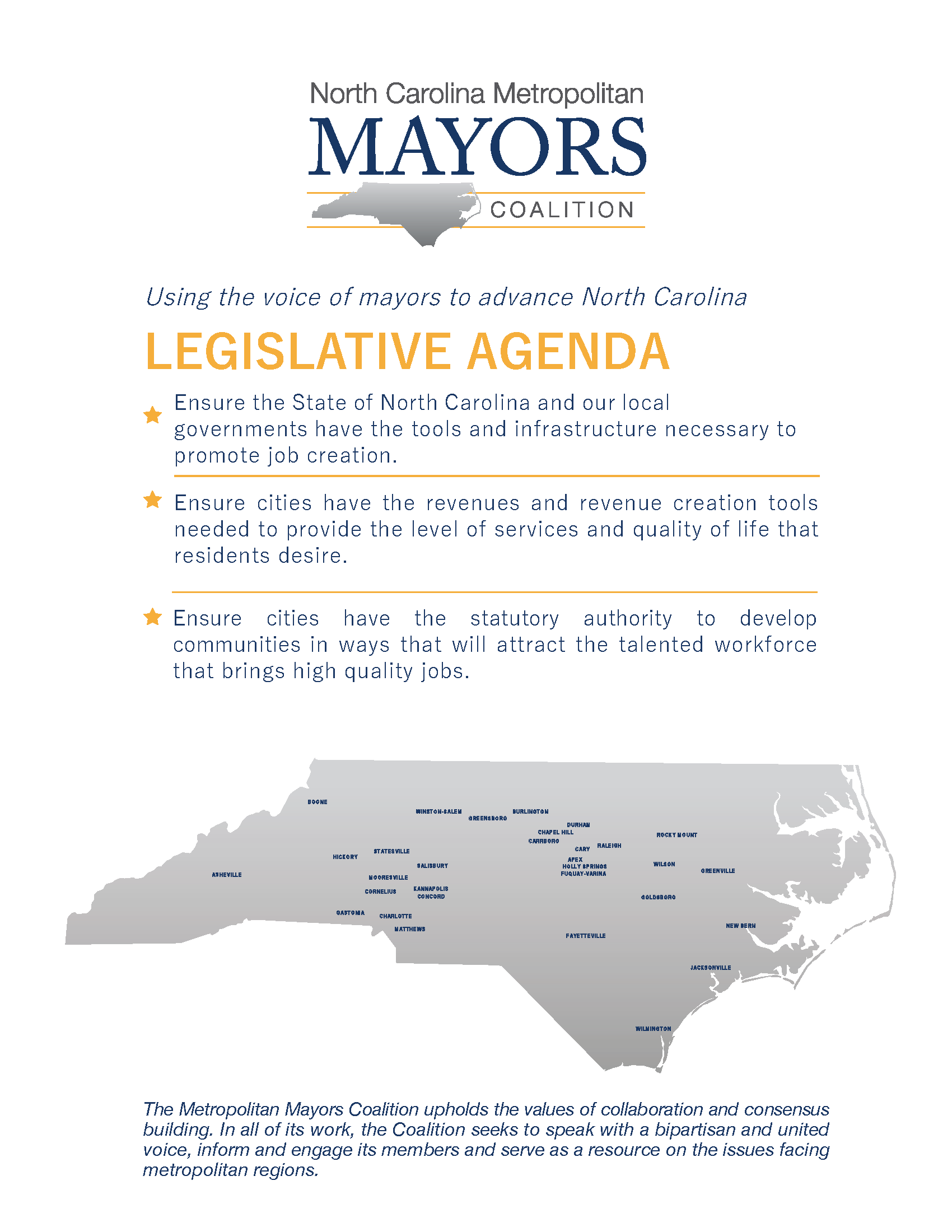
Legislative Agenda
The members of the N.C. Metropolitan Mayors Coalition understand the importance of economic growth that supports and sustains the entire state. We know that to move North Carolina forward and to build the economy of the future, we must create and attract jobs for all our citizens, not just those within our city borders. Our agenda is focused on the issues that are critical to economic development in our cities and our state – continuing to provide the services our citizens desire, ensuring safe communities, maintaining and expanding our public infrastructure, and ensuring a friendly business climate to encourage growth and attract new investment.
Transportation
- Transition the State’s reliance on shrinking gas tax revenues to other long term sustainable revenue sources such as expanded use of tolling, new regional and/or local revenue options, hybrid and electric vehicle user fees, and a comprehensive in depth study of the vehicle miles traveled model.
- Defend existing statutory roadway responsibilities between state and local government and continue the discussion about achieving a minimum standard of maintenance of state roads within municipalities.
- Continue to improve the relationship between the N.C. Department of Transportation and local government.
- Support legislation enhancing the use of public-privatepartnerships, while protecting the decision making authority of cities and towns to enter into arrangements which make wise use of public resources.
- Encourage a conversation among interested parties about raising the State’s debt limits for the purposes of transportation funding and identify a new revenue source to retire the debt.
Revenue
- Defend against attempts to shift state responsibilities to municipalities including, but not limited to, shifting state roads to local government.
- Protect existing local revenues.
- Maintain the current cost effective way to manage growth and ensure orderly planning through the extraterritorial jurisdiction (ETJ).
- Support legislation to simplify the municipal business privilege license tax while protecting existing local revenues.
- Support legislation to ensure cities receive their fair share of sale tax revenues from the county.
Public Safety
- Seek passage of H673 Street Gang Nuisance Abatement.
- Support the needs of the Justice System.
- Support legislation to modernize local E911 public safety response capabilities by establishing an equitable funding formula for all public Safety Answering points, reform the 911 Board to operate as a technical oversight body, and expand the permitted use of E911 funds to include dispatch of emergency responders.
Economic Development
- Preserve the remaining local control over new billboards and billboard conversions and support a requirement for outdoor advertising owners to replant non-obstructive vegetation around billboard sites where a selective vegetation removal permit has been issued within the planning jurisdiction of a city.
- Support opportunities for additional local revenue options that support economic development.
- Support legislation in the area of hydraulic fracturing and natural resource extraction that protects the health, safety and welfare of the citizens and environment, while facilitating necessary economic development for the overall well-being of North Carolina.
- Support the extension of the State’s current 25% film tax credit currently set to expire in 2013.
- Support the efforts of the State’s Executive and legislative branches to expand the Federal Government’s military presence in the State.
- Support continued State appropriations for life sciences.